The Internet Rewards Performance, Not Peace
The Internet Rewards Performance, Not Peace
There is a strange psychological shift that happens when people begin building a life online. At first, most creators, entrepreneurs, and influencers start with excitement. The internet feels full of possibilities. People dream about freedom, creativity, connection, financial independence, and the ability to create a life on their own terms. What often begins as self-expression slowly transforms into something much heavier. Over time, many creators discover that the internet does not simply reward creativity. It rewards constant visibility.
Modern online culture is built around performance. Social media platforms reward people who post consistently, respond quickly, stay relevant, follow trends, and remain visible at all times. The algorithm rarely pauses for exhaustion, grief, illness, motherhood, burnout, or emotional overwhelm. There is always another video to upload, another trend to react to, another comment to answer, another metric to monitor. The pressure is rarely spoken out loud, yet it exists everywhere within digital culture.
Many creators eventually begin internalizing a dangerous belief: if they stop performing, they will disappear.
This fear quietly shapes online behavior in ways many people do not fully recognize. A creator who experiences a viral moment often feels immediate pressure to recreate it. One successful post becomes an invisible standard they feel forced to maintain. Growth creates expectation. Visibility creates pressure. Attention creates responsibility. Over time, rest itself can begin to feel unproductive or even unsafe.
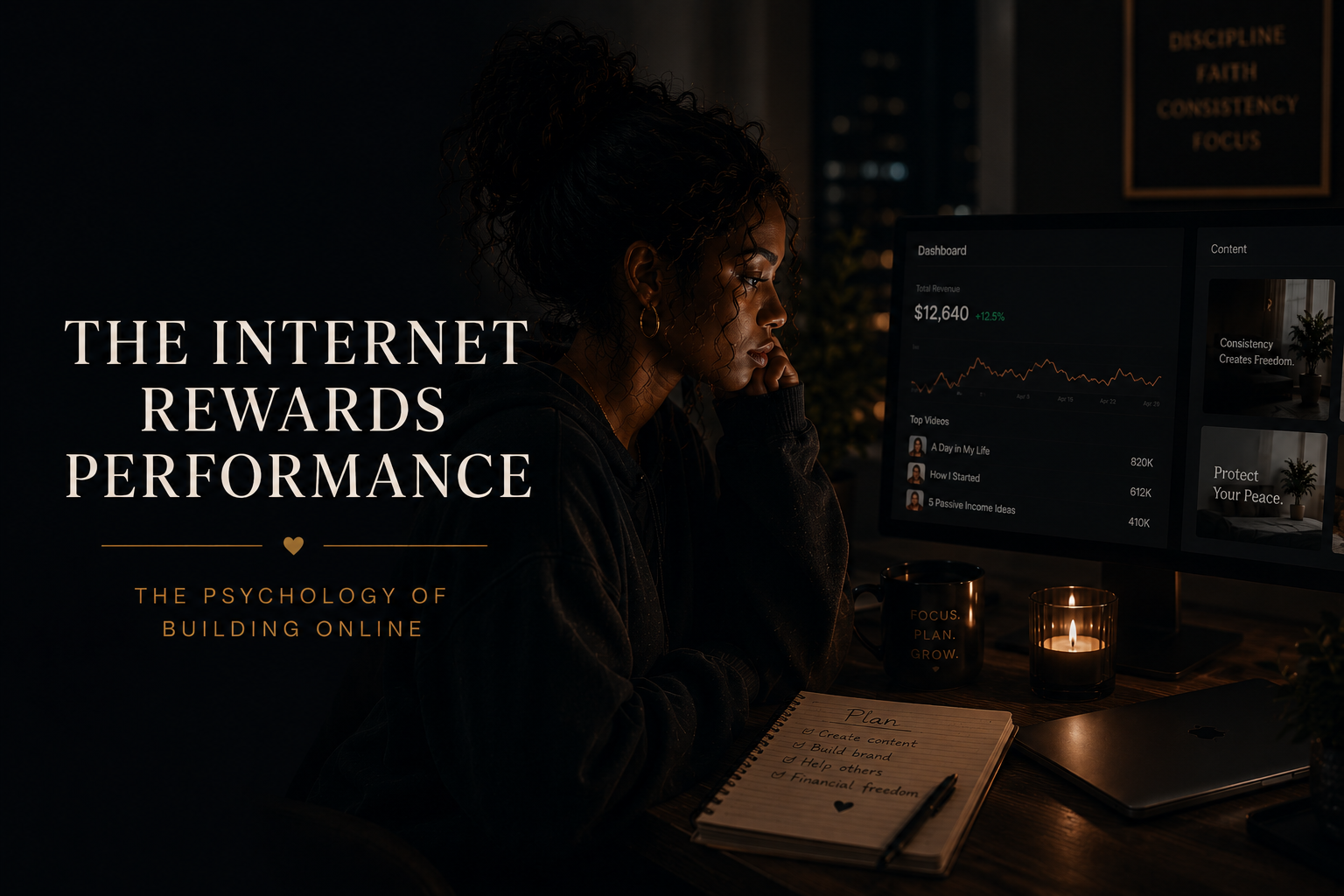
This is one of the least discussed psychological realities of building an online business. The pressure is often indirect, which makes it more difficult to identify. No one explicitly tells creators they are not allowed to rest. Instead, the pressure becomes environmental. It exists within analytics dashboards, engagement numbers, notifications, algorithm changes, audience expectations, and the constant visibility of other people appearing to succeed faster.
The internet has also normalized comparison at a scale human beings were never designed to process. Every day, creators are exposed to carefully curated images of success, productivity, wealth, beauty, discipline, and achievement. There is always someone growing faster, earning more, posting more consistently, or appearing more successful. Even moments of rest become psychologically interrupted by the awareness that someone else is still moving forward.
As a result, peace often begins to feel incompatible with ambition.
Many people building online businesses unknowingly tie their emotional well-being to engagement metrics. A successful post creates temporary emotional relief. A decline in views or engagement can feel strangely personal, even when algorithms are often unpredictable and inconsistent. This creates an unstable emotional cycle where confidence rises and falls based on audience reaction rather than internal stability.
The emotional cost becomes even more complicated because creators frequently monetize themselves, not simply a product or service. Their personality becomes part of the brand. Their lifestyle becomes content. Their opinions become content. Their healing becomes content. In some cases, even burnout itself becomes content. The line between authentic identity and online performance slowly begins to blur.
Researchers studying the creator economy have increasingly raised concerns about burnout, anxiety, emotional exhaustion, and the psychological effects of constant digital performance. Studies examining social media engagement have found strong links between online validation, self-worth, and emotional distress, particularly among creators whose income and visibility depend heavily on audience engagement. The psychological pressure attached to remaining visible online is becoming more difficult to ignore.
Part of the problem is that internet platforms are designed around stimulation and attention extraction. Outrage spreads faster than stillness. Emotional intensity spreads faster than calmness. Visibility is rewarded more consistently than balance. The internet encourages people to remain emotionally reactive because reaction keeps users engaged.
Calm people rarely go viral.
This creates a deeper internal conflict for many creators. The healthier a person becomes emotionally, the less naturally compatible they sometimes feel with internet culture itself. Healing often requires boundaries, privacy, rest, slowness, and disconnection. Social media culture encourages the opposite. It rewards constant participation, continuous accessibility, and ongoing performance.
This does not mean online business is inherently harmful. The internet has created life-changing opportunities for millions of people. Many creators genuinely love creating content and building communities online. Digital platforms have allowed people to build income, educate others, express creativity, and escape traditional limitations. The problem is not ambition itself. The problem begins when performance becomes inseparable from identity.
Eventually, many creators stop asking themselves what they genuinely want to create. Instead, they begin asking which version of themselves performs best online.
That question quietly changes everything.
Perhaps the future of a healthier online business is not learning how to become more optimized for algorithms. Perhaps it is learning how to remain human while using them. The internet may reward performance, visibility, and constant activity, but human beings still require rest, peace, connection, and emotional stability to live healthy lives.
The internet rewards performance.
Real life still requires peace.
Sources
Creator Mental Health
- Harvard T.H. Chan School of Public Health — Research on creator burnout, performance pressure, and mental health challenges within the creator economy.
Social Media & Mental Health
- American Psychological Association (APA) — Research on social media use, validation, self-esteem, and psychological well-being.
Public Health Research
- U.S. Surgeon General Advisory on Social Media and Mental Health — Research regarding the psychological effects of social media and digital environments.
Digital Behavior & Online Culture
- Pew Research Center — Research on social media habits, online engagement, and internet behavior patterns.
Mental Health & Digital Well-Being
- National Institutes of Health (NIH) and National Library of Medicine (PMC) — Peer-reviewed research on social media use, emotional regulation, stress, and anxiety.
