The Psychology of Watching Everyone Else Win
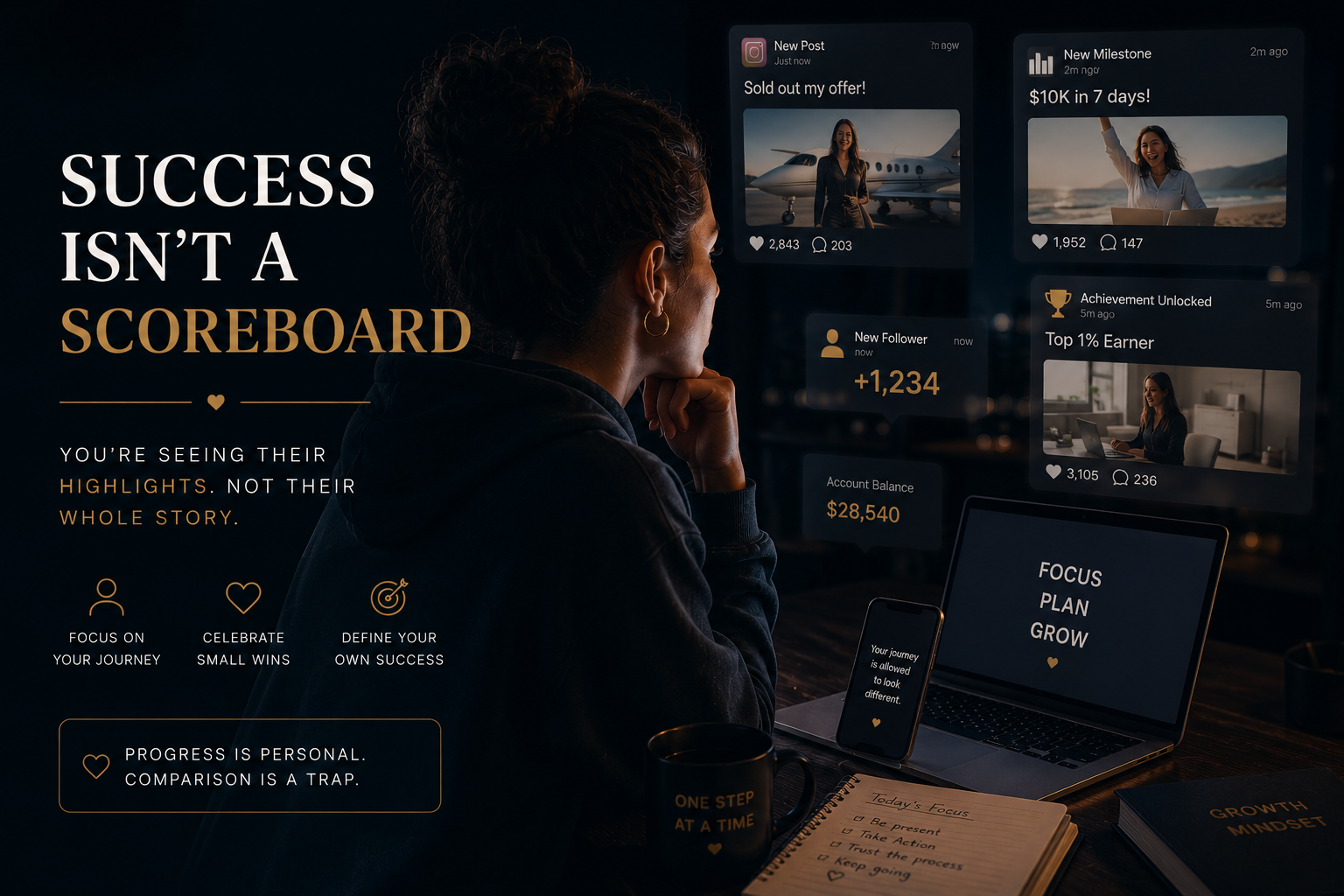
One of the strangest experiences in modern life is watching hundreds of people succeed before breakfast.
Every morning, millions of people open social media and immediately step into a world filled with promotions, milestones, launches, engagement announcements, income reports, fitness transformations, dream vacations, and personal achievements. Within minutes, someone else's success becomes the backdrop of their day.
The human brain was never designed for this.
For most of history, people compared themselves to a relatively small circle of family members, friends, coworkers, and neighbors. Today, social media exposes individuals to thousands of carefully curated success stories every week. The result is a psychological environment unlike anything previous generations experienced.
Comparison has become constant.
At first, comparison can feel motivating. Watching someone achieve a goal often inspires others to pursue their own ambitions. Healthy comparison can provide ideas, perspective, and encouragement. Problems begin when the comparison shifts from inspiration to measurement.
Instead of asking, "What can I learn from this person?"
People begin asking, "Why am I not there yet?"
That question quietly changes everything.
Social media rarely presents success in its complete form. Most platforms reward outcomes rather than process. Audiences see promotions, not years of rejection. They see thriving businesses, not abandoned projects. They see confidence, not uncertainty. The difficult, boring, and frustrating parts of success are often hidden behind the final result.
As a result, people compare their reality to someone else's highlight reel.
The emotional consequences of this habit can be surprisingly powerful. Studies examining social comparison have found that repeated exposure to idealized images and achievements can negatively influence self-esteem, life satisfaction, and emotional well-being. The more frequently people compare themselves to those they perceive as more successful, the more likely they are to experience feelings of inadequacy, discouragement, and self-doubt.
The internet accelerates this process because there is no natural stopping point.
There is always another success story.
Another launch.
Another achievement.
Another person is moving faster.
Many people unknowingly begin treating success as a competition rather than a personal journey. Instead of measuring progress against their own goals, they measure themselves against strangers whose circumstances, opportunities, experiences, and challenges are completely different.
This creates an impossible standard.
Someone building a business while working a full-time job compares themselves to a creator working on their business full-time. A beginner compares themselves to someone with ten years of experience. A person recovering from burnout compares themselves to someone currently operating at peak energy.
The comparison feels logical.
It is rarely fair.
What makes this especially difficult is that social media often creates the illusion that everyone else is succeeding simultaneously. Logically, most people understand this is not true. Emotionally, it can feel very real. When the algorithm surfaces victories, the brain starts viewing success as common and struggle as personal.
This distortion can quietly undermine confidence.
Many people begin questioning their intelligence, discipline, talent, or potential when the real issue is exposure to an unrealistic amount of comparison. They assume they are falling behind when, in reality, they are simply witnessing an unprecedented volume of other people's milestones.
The irony is that success itself rarely eliminates comparison.
People who reach one goal often discover a new group of people who appear further ahead. The finish line moves. Expectations change. New standards emerge. Comparison adapts and continues.
This suggests that the problem is not success.
The problem is the habit of measuring self-worth through relative position.
The healthiest creators, entrepreneurs, and professionals often share a common mindset. They admire other people's achievements without treating them as evidence of personal failure. They understand that someone else's success does not reduce their own potential. Progress is not a limited resource. Opportunity is not finite.
Another person's win is not proof of your loss.
This perspective sounds pretty simple, but it becomes increasingly important in a digital environment designed to display achievement. Social media can be a powerful tool for learning, networking, and inspiration. It becomes harmful when it transforms into a scoreboard.
Perhaps one of the most valuable skills in modern life is learning how to celebrate other people's success without using it as a weapon against yourself.
The internet will continue showing you people who are winning.
The real challenge is remembering that their journey is not your measurement.
Because understanding the internet starts with understanding the people using it.
Sources
Social Comparison & Self-Esteem
- American Psychological Association (APA) — Research on social comparison, self-esteem, and psychological well-being.
Digital Behavior Research
- Pew Research Center — Research on social media use, online behavior, and digital culture.
Mental Health & Social Media
- National Institutes of Health (NIH) and National Library of Medicine (PMC) — Studies examining social comparison, emotional regulation, and social media use.
Public Health Research
- U.S. Surgeon General Advisory on Social Media and Mental Health — Research regarding social comparison, online pressure, and emotional well-being.
Creator Mental Health
- Harvard T.H. Chan School of Public Health — Research on creator well-being, audience pressure, and mental health in digital environments.