Why Some People Secretly Don’t Want to Succeed Online
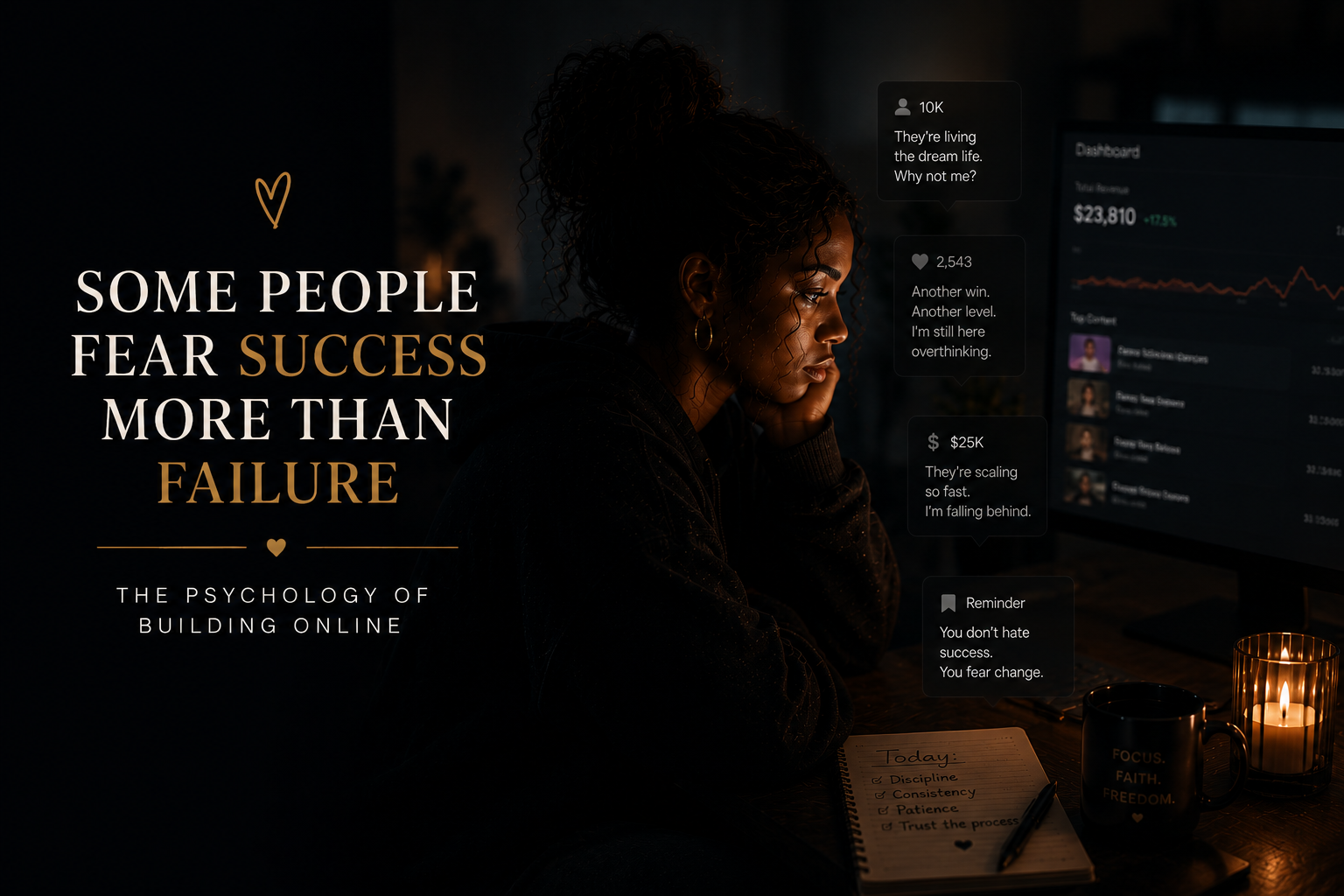
Why Some People Secretly Don’t Want to Succeed Online
Most people assume that failure online comes from laziness, lack of discipline, or lack of information. Internet culture constantly promotes the idea that success is available to anyone willing to work hard enough. Social media is filled with motivational content insisting that consistency, confidence, and determination are the only things standing between ordinary people and extraordinary success.
Yet many people who genuinely want to build an online business never fully allow themselves to succeed.
This contradiction is far more common than most people realize. Many aspiring creators buy courses, watch tutorials, make plans, study algorithms, brainstorm ideas, and dream about financial freedom for years without ever fully committing to visibility. From the outside, it can look like procrastination or inconsistency. In reality, the hesitation is often psychological.
Success online is not emotionally neutral.
For many people, building an audience online means exposing themselves to judgment, visibility, criticism, rejection, comparison, and pressure. The internet does not simply offer opportunity. It also introduces emotional risk. Every post creates the possibility of embarrassment. Every opinion creates the possibility of criticism. Every attempt at visibility creates the possibility of failure in public.
For some people, avoiding success becomes a form of emotional protection.
This is one of the most misunderstood aspects of creator psychology. People often believe they are afraid of failure, when in reality, they may also be afraid of what success could require from them. Online success changes identity. It changes relationships. It changes expectations. It increases visibility. For individuals who already struggle with self-worth, anxiety, perfectionism, or fear of judgment, that level of exposure can feel deeply threatening.
The internet rewards visibility, but visibility can feel emotionally unsafe.
Many creators unconsciously develop self-protective behaviors that keep them close to opportunity without fully stepping into it. They spend months researching instead of posting. They constantly rebrand instead of launching. They endlessly revise ideas that are already good enough. They tell themselves they are “preparing” when they are often emotionally postponing exposure.
Perfectionism frequently plays a major role in this cycle. Perfectionism is rarely just about having high standards. In many cases, it is a defense mechanism against shame. If something is never fully finished, it can never fully be judged. If a person never truly tries, failure never becomes emotionally real.
This creates a painful psychological loop where people remain trapped between desire and avoidance.
Social media intensifies this fear because success online is highly public. Traditional careers often allow people to fail privately while learning. Internet culture does not always offer the same protection. Beginners frequently compare themselves to creators who have spent years building audiences, refining skills, and understanding platforms. The result is unrealistic self-comparison before the process has even begun.
For many people, the fear is not simply “What if I fail?”
The deeper fear is often:
“What if people see me fail?”
Public visibility activates emotional vulnerabilities that many people spend years trying to avoid. The internet creates permanent records of mistakes, awkwardness, criticism, and rejection. This can make online creation feel psychologically dangerous, especially for individuals who already carry deep fears surrounding judgment or inadequacy.
Success online can also trigger identity conflicts. Some people unconsciously associate visibility with arrogance, selfishness, or instability. Others fear outgrowing relationships, attracting criticism from family members, or becoming emotionally dependent on validation. In some cases, individuals from financially unstable or emotionally difficult backgrounds may even feel guilt about surpassing the people around them.
These fears are rarely discussed openly because internet culture tends to simplify success into productivity and strategy. The emotional complexity underneath ambition is often ignored. Yet psychological research has increasingly shown that self-sabotage, fear of visibility, perfectionism, and avoidance behaviors are closely connected to emotional regulation, self-worth, and fear-based coping mechanisms.
The creator economy also intensifies emotional pressure because creators often monetize themselves rather than separate products. Their personality becomes the brand. Their voice becomes part of the business. Their visibility becomes directly connected to opportunity and income. This creates an environment where emotional vulnerability and professional success become deeply intertwined.
As a result, many people remain stuck consuming content about success rather than fully pursuing it themselves.
Research can feel safer than visibility.
Planning can feel safer than exposure.
Watching others succeed can feel safer than risking personal rejection.
The tragedy is that many people interpret this hesitation as proof that they are incapable, unmotivated, or not meant for success. In reality, they are often experiencing emotional resistance that has never been properly understood.
Wanting success and fearing it can exist simultaneously.
Human beings are complicated enough to hold both desires at once.
Perhaps this is why so many people remain trapped in cycles of preparation without action. They are not simply fighting laziness. They are negotiating with fear, identity, vulnerability, shame, and the emotional consequences of being seen.
Building online is not only a business challenge.
For many people, it is a psychological one.
Sources
Perfectionism & Achievement
- American Psychological Association (APA) — Research on perfectionism, anxiety, avoidance behaviors, and achievement-related stress.
Fear of Failure & Self-Doubt
- Harvard Business Review — Analysis of confidence, self-doubt, impostor syndrome, and professional growth.
Mental Health & Avoidance Behaviors
- National Institutes of Health (NIH) and National Library of Medicine (PMC) — Peer-reviewed research examining anxiety, emotional regulation, avoidance behaviors, and fear-based decision making.
Social Media & Public Evaluation
- Pew Research Center — Research on social media behavior, public visibility, online engagement, and the psychological effects of digital environments.
Public Health & Mental Well-Being
- U.S. Surgeon General Advisory on Social Media and Mental Health — Research regarding social comparison, online pressure, and emotional well-being in digital spaces
Because understanding the internet starts with understanding the humans using it.